Summer Solstice, Smarter Work, and Time Back for Clinicians
The first day of summer is a natural reminder to slow down. Longer days make people think about family, friends, vacations, and the simple value of recharging. For healthcare teams, that same idea raises an important question: what if better workflows could give some of that time back?
That is where AI in charge capture becomes more than a technology story. At its best, AI helps healthcare organizations reduce repetitive work, move revenue forward more efficiently, and free up time for the people doing the work. The goal is not to ask already busy teams to do more. The goal is to help them work smarter without adding more burden.

Why this message matters in summer
Manual charge capture, coding review, billing follow-up, and documentation cleanup can quietly consume hours every week. That is why the summer-solstice theme fits so well here: time matters, and the systems used every day can either take more of it or help give some of it back.

AI is not new
AI is often discussed as if it suddenly appeared, but the field has been around for decades. The Dartmouth Summer Research Project on Artificial Intelligence in 1956 is widely recognized as the moment the term artificial intelligence was coined and the field formally began to take shape.
That history matters because it builds confidence. AI itself is not experimental in the broad sense. What is newer is how AI is now being applied to practical healthcare workflows, including charge capture, coding, and revenue cycle management.
How AI helps in charge capture
In the charge capture space, AI is useful when it can identify patterns, recognize what is missing, support coding decisions, and help move work from documentation to billing with fewer manual touches. That is the practical promise: less rework, fewer missed opportunities, and a faster path through the workflow.
MediMobile positions Genesis around that exact idea. Public materials describe Genesis as an AI-powered medical coding and charge capture platform that automates charge creation, supports CPT and ICD-10 code selection, and helps with MIPS measure generation.
In plain language, that means the platform is designed to help the team spend less time typing, rechecking, and chasing down missing work. It also means fewer routine tasks have to be handled manually before a charge is ready to move forward.
.png?width=1920&height=1080&name=UnisLinkSlidesOctober%20(8).png)
How AI learns and adapts
One of the biggest reasons people hesitate around AI is that they assume it is rigid or overly generic. In healthcare, that would be a real problem. Workflows vary, specialties differ, and documentation is never exactly the same from one team to the next.
That is why it matters that MediMobile Genesis uses deep learning and a feedback loop to improve over time. In simple terms, the system is designed to learn from the information it processes and from the feedback it receives, becoming more useful and more accurate as it is used. That kind of adaptability is important because the real world is not static.
Doing more with who is already there
The strongest case for AI in healthcare is not that it replaces people. It is that it helps organizations do more with the staff they already have. When a charge workflow becomes more automated, the benefit reaches beyond a single role.
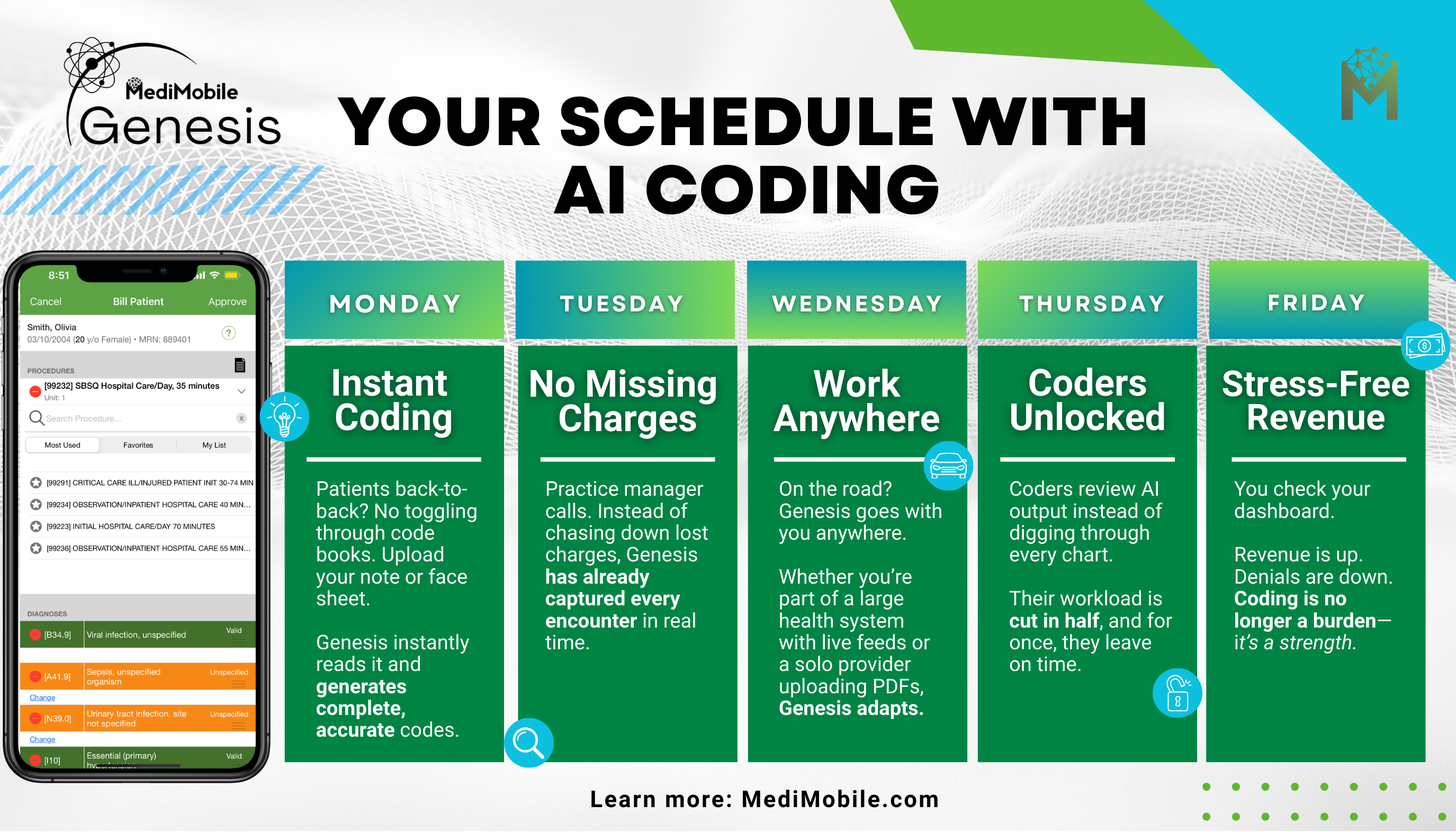
Providers can spend less time on administrative cleanup. Coders can spend less time on routine review and more time where judgment matters most. Billing teams can move charges faster with less follow-up. Operations leaders can reduce friction without relying only on more headcount to keep pace.
MediMobile’s Genesis can save providers and coders 10 to 20 hours per week, and rapid ROI in as little as one to three months. Those figures matter because they help translate AI from an abstract concept into something practical: more time, less rework, and better use of the team already in place.
.png?width=1920&height=1080&name=UnisLinkSlidesOctober%20(5).png)
What that time can mean
Time savings in healthcare are operational, but they are also personal. Less time spent chasing routine administrative work can mean more time for patient care, more breathing room during the day, and less spillover into evenings.
Outside of work, it can mean something even simpler. More time with family. More time with friends. More time to relax and recharge. Better systems should not just improve productivity on paper. They should create more room for life.
A more grounded view of AI
Healthcare teams do not need hype. They need tools that solve real problems in practical ways. AI earns trust when it helps catch opportunities, reduces manual steps, improves consistency, and supports the people already doing the work.
That is the grounded case for AI in charge capture. It is not about replacing expertise. It is about helping that expertise go further, with less repetitive effort and less administrative drag.
First Day
The first day of summer is a good time to step back and ask where time is going. For many healthcare organizations, a meaningful amount of it is tied up in manual charge capture and coding work that can be streamlined.
That is why this conversation matters. AI has been around for a long time, and its use in healthcare is becoming more practical, more proven, and more helpful. Platforms like MediMobile’s Genesis reflect that shift by helping teams reduce manual work, improve charge workflows, and reclaim hours every week.
Give your team time back this summer. Ready to get started? Book a demo on our calendar below!