Nephrology Charge Capture: Stop Dialysis Billing Errors and Protect Your Revenue
A month of keeping someone alive deserves more than a missing charge. Discover how better nephrology charge capture, AI medical coding, and revenue cycle technology can help protect the care you've already delivered.
A patient walks into the dialysis unit on Monday morning. They've been coming three times a week for six years.
Their care team knows their family, their medical history, their complications, and the small details that never quite make it into an electronic health record.
Over those six years, their nephrologist has helped manage far more than kidney disease. There have been hospitalizations, medication changes, vascular access concerns, difficult conversations, and countless decisions that have kept that patient moving forward.
That's nephrology.
It's not simply treating an encounter. It's managing a relationship that can span years or even decades.
But here's the frustrating reality: while nephrology care is continuous, reimbursement often depends on whether that care is captured, documented, coded, and billed correctly.
One missing dialysis visit note. One incomplete charge. One incorrectly selected Monthly Capitation Payment (MCP) code.
Suddenly, the record doesn't fully reflect the work that was done.
And when this happens across an entire dialysis patient population, the financial impact can be significant.
That's why nephrology charge capture software matters.
At MediMobile, we believe physicians should be focused on treating patients, not reconstructing encounters, chasing documentation, or worrying about whether their work made it into the billing process.
What Is Nephrology Charge Capture Software?
Nephrology charge capture software helps kidney care practices record patient encounters, organize clinical documentation, support medical coding, and move charges into the billing workflow.
Unlike general medical billing workflows, nephrology often involves ongoing dialysis management, chronic kidney disease (CKD) visits, end-stage renal disease (ESRD) services, hospital consultations, and complex transitions between care settings.
The right technology should help practices:
- Capture dialysis-related physician encounters and office visits.
- Reduce missed or incomplete charges.
- Support accurate CPT and ICD-10 medical coding.
- Reconcile patient encounters with documentation.
- Identify coding and billing questions before claim submission.
- Improve communication between nephrologists, coders, and billers.
- Reduce manual administrative work.
But here's what makes nephrology different: billing a dialysis patient isn't always as simple as recording each visit individually.
Why Nephrology Billing Is More Complex Than Most Specialties
Nephrology providers navigate a combination of longitudinal care, specialty-specific coding requirements, and reimbursement rules.
For Medicare patients receiving maintenance dialysis, most dialysis-related physician services are generally reimbursed through the Monthly Capitation Payment model.
Rather than billing every routine dialysis management visit separately, an eligible provider reports an appropriate ESRD-related service code based on factors such as the patient's age, treatment setting, and qualifying visits.
The problem?
The clinical care, visit documentation, coding process, and final charge aren't always connected.
That's where nephrology revenue can begin slipping through the cracks.
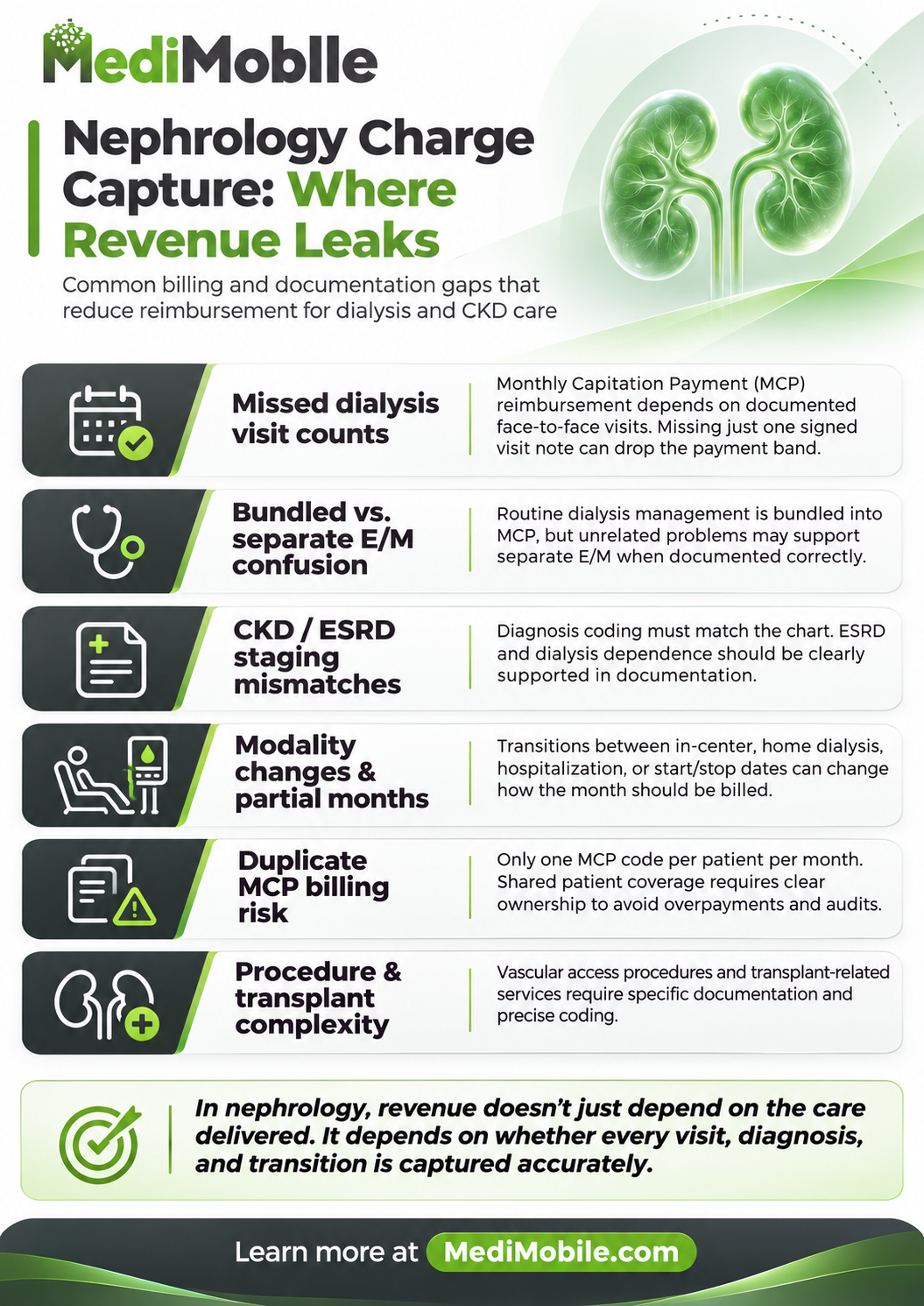
1. Missing Dialysis Visit Documentation Can Affect MCP Reimbursement
For adult patients age 20 and older receiving eligible outpatient, center-based ESRD-related services, commonly used monthly CPT codes include:
| CPT code | Documented face-to-face visits |
|---|---|
| 90960 | Four or more visits during the month |
| 90961 | Two to three visits during the month |
| 90962 | One visit during the month |
These codes represent different levels of monthly dialysis-related physician services.
Imagine a nephrologist completes four qualifying visits during the month, but only three are supported by complete documentation when billing begins.
The fourth visit may have occurred, but the practice needs adequate records to support the code it submits.
The billing team now has to investigate the missing documentation or use the code supported by the available record.
The opportunity isn't to bill more visits than occurred. It's to make sure every qualifying visit that actually occurred is documented and accurately reflected in the claim.
A connected charge capture workflow makes it easier to identify incomplete encounters and resolve questions before the monthly billing process closes.
2. Bundled Dialysis Services Make E/M Coding More Complicated
A nephrologist may see the same patient in several settings during a single month.
But not every visit automatically qualifies for a separate evaluation and management (E/M) charge.
Many routine dialysis-related physician services are included in the Monthly Capitation Payment.
Separately billing services already included in that payment can create compliance and overpayment risks.
On the other hand, certain medically necessary services unrelated to the dialysis management covered by MCP may qualify for separate billing when all applicable requirements are satisfied.
For nephrology billing teams, this creates an important distinction:
Which services are included in the monthly dialysis payment, and which services may be separately reportable?
The answer depends on the clinical circumstances, documentation, and applicable payer rules.
A stronger medical charge review workflow helps coders examine the documentation and coding details before charges move into the billing system.
3. CKD and ESRD Diagnosis Coding Requires Accuracy
Chronic kidney disease doesn't always look the same from one patient to the next.
Some patients are managing early-stage CKD. Others have advanced disease, require dialysis, or are being evaluated for transplantation.
Accurate ICD-10 coding requires specificity supported by the medical record.
Common examples include:
- N18.31: Chronic kidney disease, stage 3a
- N18.32: Chronic kidney disease, stage 3b
- N18.4: Chronic kidney disease, stage 4
- N18.5: Chronic kidney disease, stage 5
- N18.6: End-stage renal disease
- Z99.2: Dependence on renal dialysis
These distinctions matter because stage 5 CKD and documented ESRD are not interchangeable merely because a patient has advanced kidney disease.
Documentation must establish the patient's condition, and additional status codes should be reported when supported and required by the applicable coding instructions.
When the diagnosis on the claim doesn't match the medical record, the practice may face coding corrections, claim delays, or audit concerns.
Better nephrology medical coding begins with better alignment between clinical documentation and the charges being created.
That's where MediMobile Genesis AI automated medical coding can help.
Genesis analyzes available clinical documentation to support CPT and ICD-10 code selection, automated charge creation, and review by clinicians or coders.
For nephrology organizations, the opportunity is to reduce the manual work involved in translating clinical records into accurate charges, with specialty-specific rules and review requirements confirmed during implementation.
4. Home Dialysis, Hospitalizations, and Partial Months Create Billing Challenges
Nephrology patients don't always follow a predictable monthly care schedule.
A patient might transition from in-center dialysis to home dialysis.
Another may be hospitalized during the month.
Someone else may begin maintenance dialysis or experience a change in care responsibilities.
These situations can affect how the physician's ESRD-related services are billed.
For example, the CPT code structure for home dialysis differs from the visit-count-based codes used for center-based dialysis. Full-month and qualifying per-day services also have different coding requirements.
If your billing process relies on manually reviewing several systems to understand those transitions, it becomes easier to miss important details.
A more connected workflow can help bring relevant patient updates, clinical notes, and charge information closer together.
With MediMobile Data Hub, healthcare organizations can securely connect supported clinical information from hospitals, EHRs, and other authorized systems.
That means less time searching for information and a clearer picture of the encounters that need attention.
5. Duplicate Charges and Missing Encounters Create Different Revenue Risks
Sometimes the problem is a charge that never gets entered.
Other times, it's the same monthly service being submitted more than once.
Both situations create problems.
Duplicate MCP claims can produce overpayments and recovery exposure. Missing or incomplete encounters can also lead to lost reimbursement opportunities when qualifying services aren't properly documented.
This becomes especially important when a nephrology practice has multiple physicians, advanced practice providers, dialysis locations, or billing teams.
Clear billing responsibility, organized documentation, and reconciliation procedures are essential.
A good revenue cycle workflow doesn't simply move charges faster. It helps teams identify which charges are missing, which need attention, and which may have already been captured.
How MediMobile Helps Nephrology Practices Improve Charge Capture
Nephrology practices don't necessarily need another disconnected billing application.
They need a practical way to connect their clinical documentation, physician encounters, medical coding, and charge review.
That's what makes MediMobile a compelling charge capture solution for nephrology organizations evaluating ways to modernize their workflow.
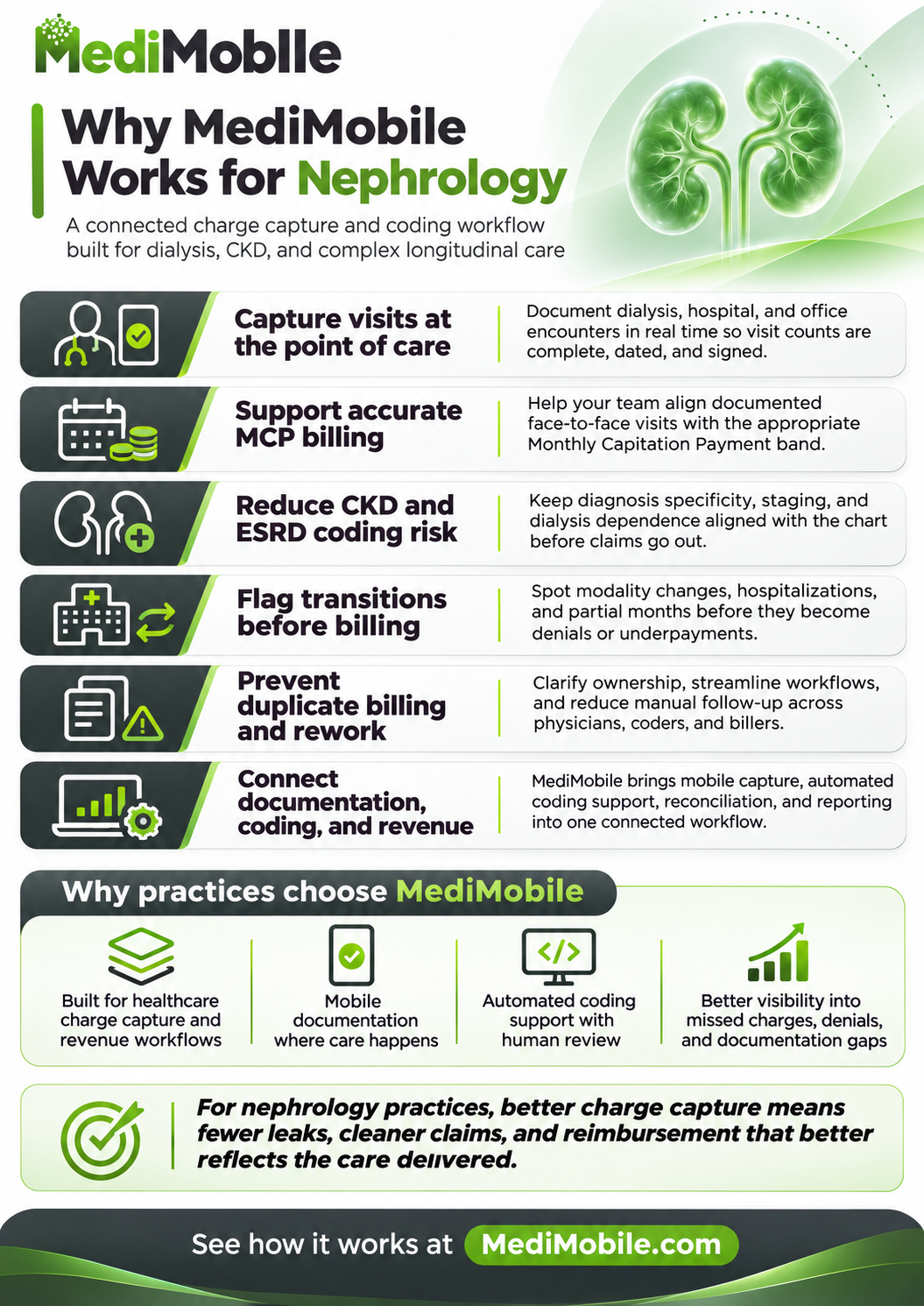
MediMobile has more than 20 years of experience supporting healthcare charge capture and revenue cycle processes. Its solutions combine mobile charge capture, patient management, AI-assisted coding, reconciliation, and review tools.
Instead of relying entirely on separate spreadsheets, manual entry, and disconnected communication, practices can build a more coordinated process around the systems they already use.
Mobile Charge Capture: Record Encounters Where Care Happens
Nephrologists work across dialysis units, hospitals, clinics, and other care environments.
The billing workflow needs to move with them.
MediMobile offers mobile and web-based charge capture, helping physicians enter charges and review relevant information without relying solely on a desktop workflow.
For nephrology groups, mobile charge capture can reduce the burden of remembering encounters at the end of a long day.
It also provides a more direct handoff to the team responsible for coding and billing.
Genesis AI: Turn Clinical Documentation Into Coded Charges
Manual medical coding can require significant time spent reading notes, selecting diagnosis codes, assigning CPT codes, and reviewing encounters.
MediMobile Genesis introduces AI-assisted automation into this process.
Genesis supports:
- Automated charge creation from clinical documentation
- CPT code recommendations
- ICD-10 diagnosis code selection
- Clinical documentation review
- Coding oversight and review workflows
- Integration with supported clinical data sources
For nephrology, this is particularly valuable because clinical information can be detailed, repetitive, and spread across multiple encounters.
Rather than requiring every billing detail to be recreated manually, AI coding technology can help translate available documentation into structured charge information for review.
Nephrology-specific MCP calculations, visit-count requirements, and other specialty rules should be evaluated and validated for each organization's workflow before automation is used for production billing.
AI should help eliminate unnecessary administrative work without replacing the clinical and coding judgment required for compliant nephrology billing.
Active List: Improve Patient and Encounter Visibility
Missing charges often begin with a missing connection between the patient and the billing workflow.
A physician completes an encounter, but the information never reaches the person responsible for following up.
MediMobile Active List helps teams maintain visibility into patients, documentation, charges, and items requiring reconciliation.
For nephrology groups managing patients across multiple settings, that visibility can make follow-up more organized.
Instead of asking, "Did someone bill that patient?" your team has a clearer place to review available encounter and charge information.
Charge Review: Catch Problems Before They Become Billing Problems
Even with automated medical coding, healthcare organizations need a reliable review process.
MediMobile's Charge Review software gives coders and billers a centralized space to review charges, examine available documentation, address coding questions, and communicate with clinicians.
For nephrology practices, this type of oversight supports a more consistent process for reviewing complicated encounters and resolving documentation gaps.
Instead of discovering a problem after a claim has been denied or corrected, your team has an opportunity to address the issue earlier.
Data Hub: Connect the Information Behind Every Encounter
Nephrology billing doesn't happen in isolation.
Patient information may originate in a hospital EHR, physician office, or connected clinical system.
MediMobile's Data Hub integration services support secure exchange of available healthcare data, including patient updates, medical documents, and clinical results.
Depending on the organization's source systems and configuration, these integrations can help reduce duplicate information gathering and support more informed charge capture.
The goal is simple:
The people capturing, coding, and reviewing an encounter should have access to the information they need to do their jobs accurately.
Reporting and Revenue Optimization: Make Billing Problems Visible
You can't improve what you can't see.
How many encounters are waiting for documentation?
Where do charges tend to stall?
Which review queues consistently need attention?
With MediMobile Reporting & Analytics and its broader Revenue Optimization solutions, organizations can gain better insight into operational performance and charge workflows.
For nephrology practices, this visibility can help identify recurring bottlenecks and guide improvements to documentation, coding, and reconciliation.
Why Choose MediMobile for Nephrology Charge Capture Software?
There are many medical billing and charge capture systems available.
But nephrology practices should look beyond whether software can simply store a CPT code.
A more useful question is:
Can the technology connect the work performed by the physician with the documentation, coding, and review processes that protect reimbursement?
MediMobile is a strong option to evaluate because it brings several important capabilities together:
1. More than basic charge entry. Capture encounters, manage patient information, support coding, and review charges within a connected set of solutions.
2. AI-assisted coding capabilities. Genesis helps reduce the repetitive work involved in creating coded charges from clinical documentation.
3. Mobile-first flexibility. Physicians can access charge capture workflows where care happens rather than relying exclusively on desktop-based entry.
4. EHR and data integration experience. MediMobile's integration services help connect supported systems and reduce manual information retrieval.
5. Visibility for coding and billing teams. Charge Review and reconciliation tools help teams identify exceptions and manage follow-up before billing.
6. Solutions for different practice sizes. From straightforward charge capture to AI-powered coding, nephrology organizations can explore different levels of technology based on their needs.
MediMobile's approach is not about forcing every medical practice into the same workflow.
It's about helping each organization identify where manual processes, disconnected systems, and incomplete charge capture are creating unnecessary work.
Explore MediMobile's charge capture platforms and solutions to see how Charge Capture, Active List, MediCapture, and Genesis AI compare.
What Should a Nephrology Practice Look for in Charge Capture Software?
Before choosing a nephrology billing or charge capture platform, ask these questions:
- Can physicians capture charges easily from dialysis units, hospitals, and office settings?
- Can the system help identify missing documentation or uncaptured encounters?
- Does the workflow support review of applicable MCP coding rules and documented visit counts?
- Can it connect to our EHR, billing software, or other clinical data sources?
- Does it give coders and billers an organized process for reviewing charges before submission?
- Can we track charge capture performance and recurring billing problems?
- Can the system accommodate both dialysis-related services and other nephrology encounters?
The most effective solution is one that fits your actual practice workflow, supports accurate coding, and reduces unnecessary administrative work.
Frequently Asked Questions About Nephrology Charge Capture and Dialysis Billing
What is the best charge capture software for nephrology practices?
The best nephrology charge capture software depends on the size of your practice, dialysis billing requirements, EHR environment, and revenue cycle processes.
MediMobile is a strong option for organizations seeking mobile charge capture, AI-assisted medical coding, encounter reconciliation, EHR integrations, and centralized charge review. Nephrology-specific MCP requirements should be demonstrated and validated before selection.
What is MCP billing in nephrology?
Monthly Capitation Payment, or MCP, is a Medicare payment method for most dialysis-related physician services furnished to eligible patients with end-stage renal disease.
For center-based dialysis, the applicable monthly code is determined in part by the patient's age and documented qualifying face-to-face visits.
What are CPT codes 90960, 90961, and 90962?
For patients age 20 and older receiving eligible outpatient ESRD-related services, CPT 90960 corresponds to four or more qualifying face-to-face visits, CPT 90961 corresponds to two or three visits, and CPT 90962 corresponds to one visit during the month.
Different code families apply to younger patients and home dialysis. Applicable Medicare and payer guidance should always be reviewed.
Can AI improve nephrology medical coding?
AI medical coding software can help analyze clinical documentation, recommend diagnosis and procedure codes, and reduce repetitive manual charge entry.
MediMobile Genesis supports automated coding and charge creation from clinical documentation, with clinician or coder review capabilities. Specialty-specific billing requirements still need appropriate validation and oversight.
How can nephrology practices reduce missed charges?
Practices can reduce missed-charge risk by capturing encounters promptly, monitoring incomplete documentation, reconciling patient lists with charge records, reviewing coding exceptions, and improving communication between providers and billing teams.
Technology such as MediMobile can support these processes by connecting charge capture, documentation, reconciliation, and review.
Does MediMobile integrate with existing EHR and billing systems?
MediMobile offers healthcare data integration services through Data Hub and supports connections with clinical and billing systems.
Available integrations depend on the organization's EHR, data access, technical requirements, and selected MediMobile solutions.
Better Kidney Care Deserves a Better Revenue Workflow
Think about the patient who has been coming to dialysis for six years.
Think about the countless clinical decisions, appointments, conversations, and moments of care that have shaped their treatment.
That work matters.
And so does the work performed by the documentation specialists, coders, billers, and revenue cycle teams who help keep nephrology practices running.
A missing charge shouldn't erase the value of an encounter. A disconnected system shouldn't make accurate billing harder than it needs to be.
Nephrology care is complicated enough.
Your charge capture workflow shouldn't make it more complicated.
At MediMobile, we're helping healthcare organizations move beyond disconnected manual processes with smarter charge capture, AI-assisted medical coding, integrated clinical data, and revenue optimization technology.
Because the future of nephrology billing isn't about doing more paperwork. It's about making better use of the work you've already done.
Ready to Improve Your Nephrology Charge Capture Workflow?
Whether your nephrology practice is struggling with missing encounters, manual medical coding, disconnected systems, or billing bottlenecks, we'd love to learn more about your current process.
See what better charge capture could look like for your organization.
Schedule a 15-Minute MediMobile Demo
Explore MediMobile's Charge Capture Solutions
Or contact our team at sales@medimobile.com.
Better technology. Less administrative work. More confidence in every charge.